what is controller-runtime?
controller-runtime is official set of Go libraries used to build custom operators and controllers in kubernetes.
How does a sample custom controller looks like in kubernetes
# main.go

package main

import(
 "context"
 "sigs.k8s.io/controller-runtime/pkg/client"
 ctrl "sigs.k8s.io/controller-runtime/pkg/manager"
)

func main() {
  cfg := ctrl.GetConfigOrDie()
  mgr, err := ctrl.NewManager(cfg, ctrl.Options{})
  handleErr(err)

  r := &PodCounter{Client: mgr.GetClient()}

  err = r.SetupWithManager(mgr)
  handleErr(err)

  err = mgr.Start(ctrl.SetupSignalHandler())
  handleErr(err)

}

func (r *PodCounter) SetupWithManager(mgr ctrl.Manager) error {
  return ctrl.NewControllerManagedBy(&mgr).
           For(&corev1.Pod{}).
           Complete(r)
}

func (r *PodCounter) Reconcile(ctx context.Context, req ctrl.Request) (ctrl.Result, error) {
  podList := &corev1.PodList{}
  if err := r.List(ctx, podList); err != nil {
    return ctrl.Result{}, err
  }
  log.Printf("Number of pods: %d", len(podList.Items))
  return ctrl.Result{}, nil
}
there are way too many information hidden in here and for us to distill this completely, lets understand each and everything in a bit more details.
config
It’s a *rest.Config from k8s.io/client-go/rest. It holds everything that is needed to talk to the kube api-server.
- the server url
- credentials (token, client certs)
- ca bundle
- qps
- burst limits, etc
This part gets the config in the following order
--kubeconfigflagKUBECONFIGenv var- in-cluster config (via the service account mounted in a pod)
~/.kube/config
client.Client
The PodCounter{} struct is just a holder which if needs to be a reconciler has to implement the Reconcile(ctx, Request) as part of the interface contract.
Embedding client.Client into the struct is an approach where we inject a reference to the client of the manager that we create as part ctrl.NewManager.
things NewManager creates
NewManager builds a cluster object that wires several pieces from the rest.Config
- An HTTP client: which owns the actual connections (to talk to API server)
- A REST Mapper: which maps a Go type or GVK to a URL path
- A cache: registry of informers
- A client: which reads from cache and writes through REST.
- An API reader: an uncached client for when you need fresh reads from API-server.
What is an Informer?
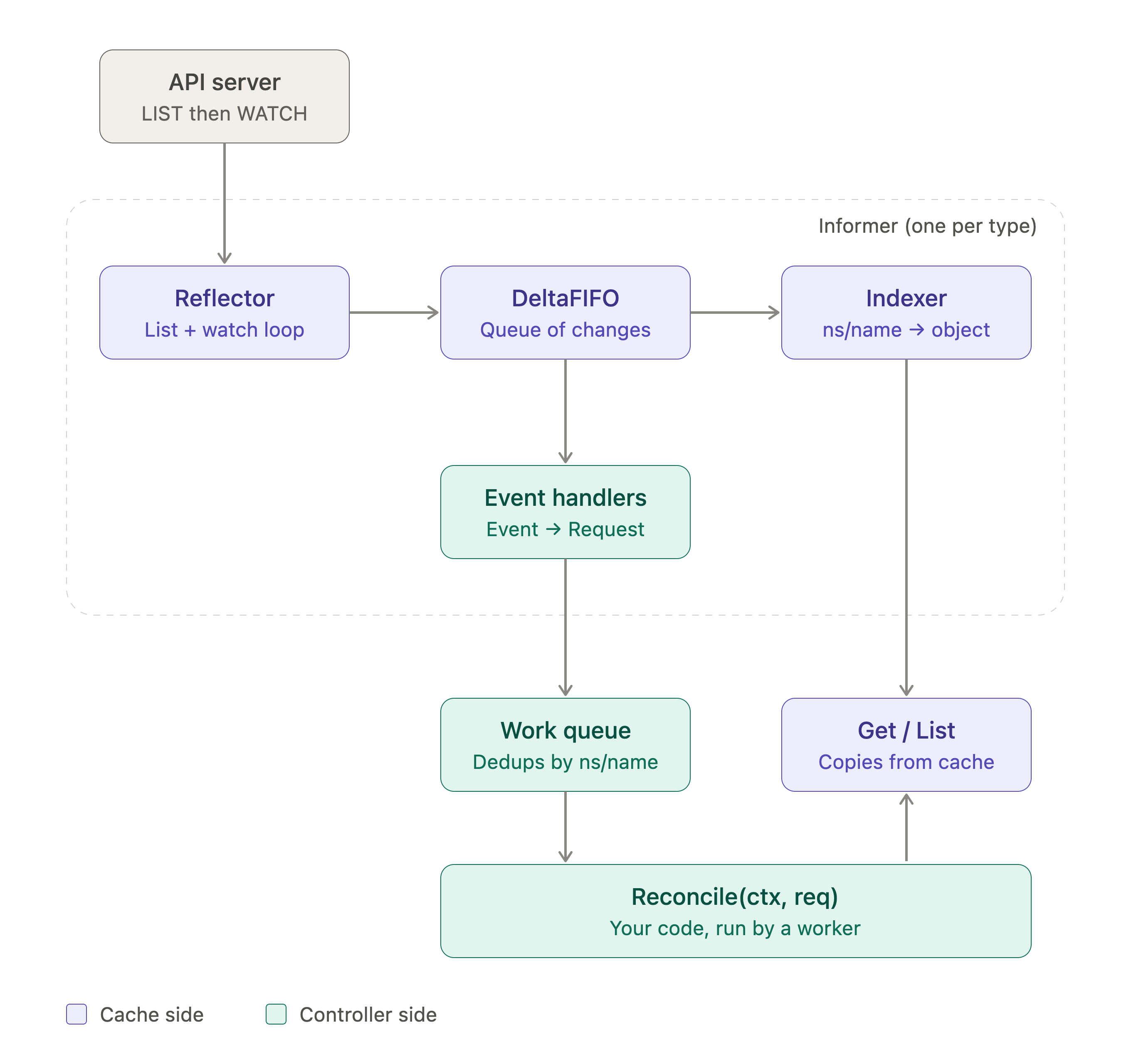
Informer is a local cache kept in sync with the kube api-server, plus an event notification system on top.
It has these following components
- Reflector: talks to the API server
- Delta FIFO: is a queue of changes from the Reflector
- Indexer: is the in-memory store, a map keyed by
namespace/namewith optional secondary indexes. - Handlers are callback that turn events into reconcile Requests.
How does SetupWithManager works?
func (r *PodCounter) SetupWithManager(mgr ctrl.Manager) error {
  return ctrl.NewControllerManagedBy(&mgr).
           For(&corev1.Pod{}).
           Complete(r)
}
- The
NewControllerManagedBytakes in the manager as the manager controlls the queue, cache and the client - The
Forestablishes the primary resource of the controller on which it reconciles. It’s only a type marker (the builder looks it up in the scheme)- The informer is created for Pods (when this gets executed)
- Every Pod event is turned into a Request{namespace, name} of that pod and put on in the work queue.
- The
Completefinishes the chain and maps it to the reconcilerrand does the real work as last step of the builder pattern.- build the controller with the work queue.
- stores
ras the thing to call when the request is taken off the queue. - registers the controller with the manager.